
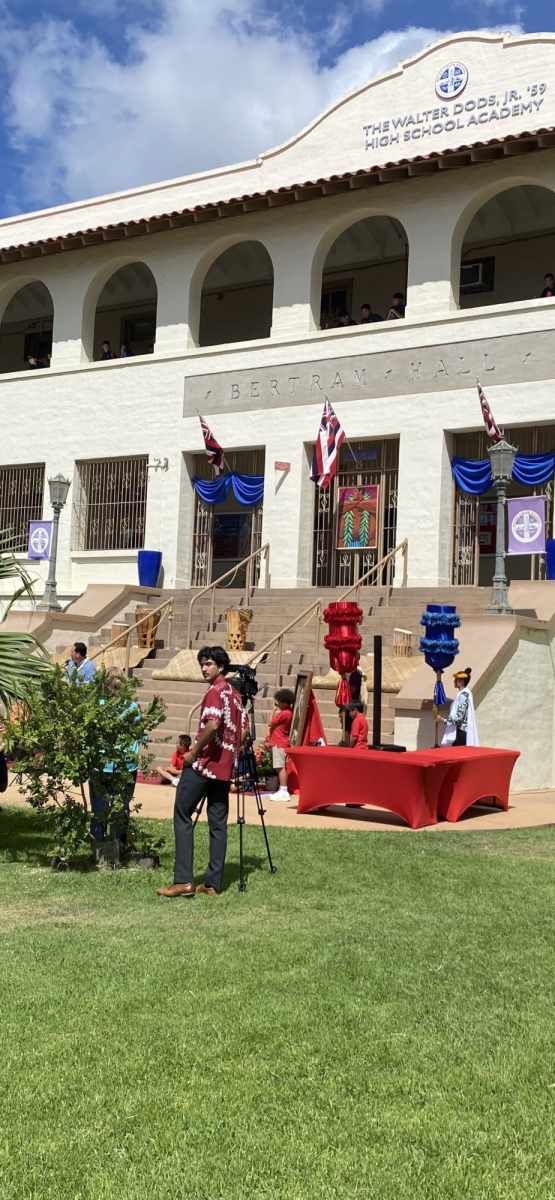
Kamehameha Schools is once again the subject of a lawsuit challenging its admissions policy. Brought into court by the Virginia-based group, Students for Fair Admissions, this lawsuit necessitates a vigorous defense of Kamehameha Schools (KS). We must not fall into the trap of indifference. This isn’t merely a legal quarrel; it is a united effort that requires all of us to defend the legacy of the school and, in effect, the cultural fabric of Hawaii. That being said, let this be known: Saint Louis School stands with Kamehameha Schools.
It’s often not adequately recognized just how much KS does for Native Hawaiians all throughout the state. The school grants millions of dollars in scholarships to in-need students of Hawaiian descent. For example, the Kipona Scholarship, Kamehameha’s third-largest external financial aid program, gave $7.1 million to students in 2024, according to Civil Beat. This is a reflection not only of the school’s generosity but also of the remarkable role KS plays in uplifting the Native Hawaiian community.
What’s even more remarkable is the fact that Kamehameha Schools grants scholarships to students who don’t even attend the school. Perhaps one of the largest recipients of this singular goodwill is Saint Louis School, with about 60 percent of the student body being of Native Hawaiian ancestry.
I can personally attest to this. As a Saint Louis student, I’m fortunate to have benefited from Kamehameha Schools’ generosity. My education wouldn’t be possible without the financial support that KS has provided to my family and me. However, I am not the only one. Kamehameha Schools has had a tangible impact on thousands of students across the state. My example, for which I remain forever grateful, is but one found in Kamehameha’s extensive network of generosity.
On a broader level, this lawsuit invokes questions on how Hawaii is perceived on the mainland. The lawsuit itself is indicative of a lack of historical knowledge surrounding the creation of Kamehameha Schools. Students for Fair Admissions argues that the school’s admissions policy – which gives preference to Native Hawaiians – is racially discriminatory.
While in principle one can see the merits of this argument, it doesn’t take into account the distinguishing factor, which is that Kamehameha Schools was established for the purpose of serving Native Hawaiians through education. Furthermore, the school receives no federal or state funding and operates via its endowment fund. This is the central flaw in the Virginia organization’s argument: it makes categorical judgments without considering the historical context and purpose behind Kamehameha Schools’ founding. This view is reinforced by the 9th U.S. Circuit Court of Appeals’ 2006 decision to uphold the school’s admissions policy in a similar case, Doe vs. Kamehameha Schools. Following a similar line of argument, the plaintiff in that case challenged KS’ admissions policy on racial discrimination grounds. The court ruled, however, that the admissions policy didn’t constitute racial discrimination, citing unique historical and cultural circumstances. Such could be said for the current lawsuit.
The road ahead is sure to be long. Kamehameha Schools ought to be confident knowing that precedent and history are on their side. By the same token, Saint Louis will always remain faithful to our friend. Although we may be fierce opponents on the football field, the alliance between our two schools is inviolable. As Proverbs 17:17 says, “A friend loves at all times, and a brother is born for a time of adversity.” So we will be for Kamehameha Schools.